Secondary Coaching Network
Overview and Description
The Secondary Coaching Network is an opportunity for middle and high school coaches, teacher leaders, and department chairs to enhance knowledge and implementation of research-based practices in adolescent literacy.
Definition of Coaching
“Coaching is a partnership built on trust, reflection, and steady growth. It gives people a consistent place to think about their practice, talk through decisions, and notice what students are showing them each day. In coaching, no one is being judged. The goal is clarity, confidence, and support.
Coaching helps people connect what they’re teaching to who they’re teaching: their students’ identities, cultures, strengths, and lived experiences. It invites people to try strategies, reflect on what worked, and make meaningful adjustments that support student learning.
Good coaching doesn’t rush, demand, or direct. It listens. It asks questions. It helps people see possibilities they may not have seen before.
At its core, coaching is how schools build shared understanding, stronger practice, and classrooms where every student feels seen, supported, and capable."
3P Framework: Emphasizing Engaging, Authentic, and Meaningful Instructional Approaches
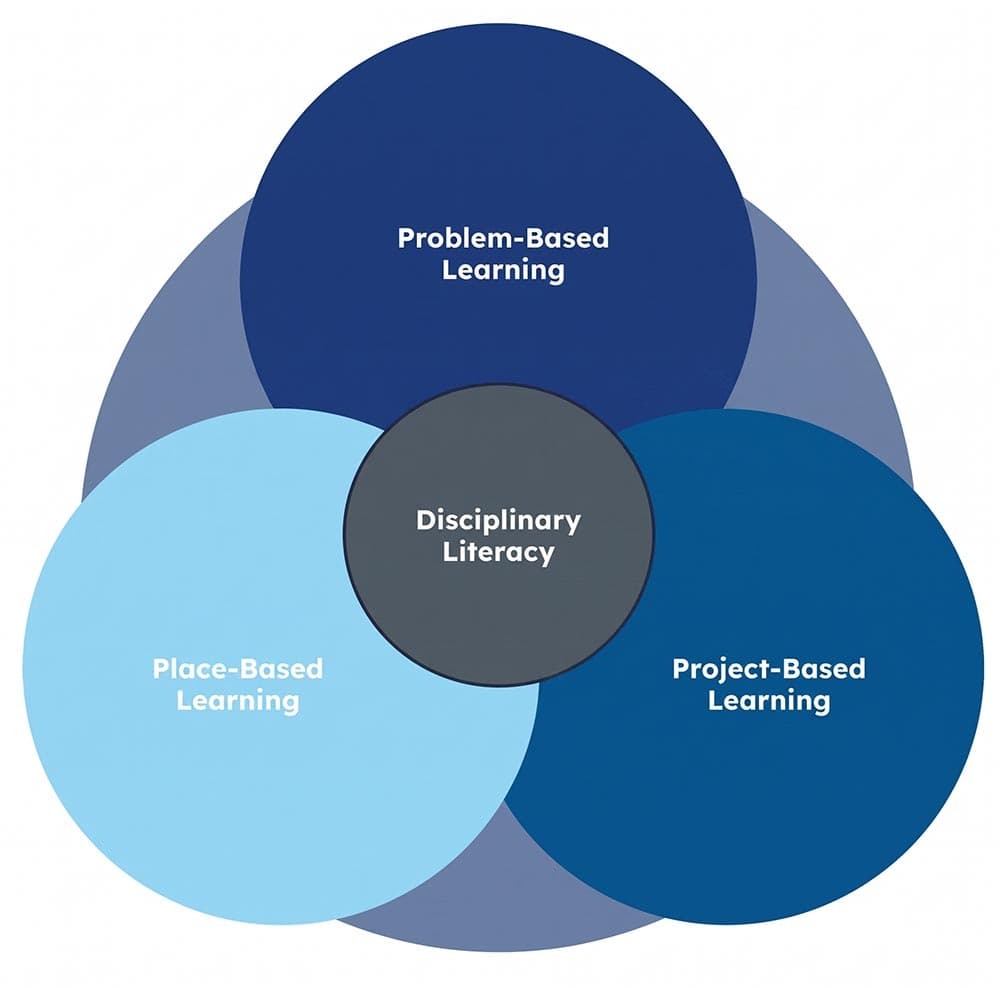
Problem-Based Learning
- Centers on solving real-world problems.
- Encourages critical thinking, collaboration, and inquiry.
- Students take ownership of their learning by actively solving problems.
Project-Based Learning
- Involves creating a tangible project as the outcome of learning.
- Students explore a topic deeply and apply knowledge in practical, hands-on ways.
- Promotes creativity, innovation, and cross-disciplinary connections.
Place-Based Learning
- Rooted in the local context and environment.
- Leverages the community, geography, and culture as a foundation for learning.
- Fosters a sense of connection, relevance, and stewardship for the students' surroundings.
Resources/Links
- Essential Instructional Practices for Disciplinary Literacy in the Secondary Classroom (PDF)
- Doing Disciplinary Literacy: Teaching Reading and Writing Across the Content Areas
- Arise: The Art of Transformational Coaching
- Essential School-Wide Practices in Disciplinary Literacy: Grades 6 to 12 (PDF)
- Place, Problem, and Project-Based Learning Framework
- Enhanced understanding of disciplinary literacy for teachers and students
- Opportunities to engage in place-, problem-, and project-based learning at locations throughout Wayne County
- Increased capacity of secondary literacy leaders through adult learning principles
- Increased implementation through targeted coaching
- Collaborate around humanizing and equitable ways to use data and assessment.
- 2 years
- 42 secondary coaches
- 5 sessions per year
- 3P both in the learning and in the venue selections
- 32 Coaching Touchpoints
- 150 contact hours
Maps - People and Places
- Academy for Business and Technology (Melvindale)
- Allen Park Public Schools
- Barack Obama Leadership Academy (Detroit)
- Chandler Park Academy (Harper Woods)
- Covenant House Academy (Detroit)
- Detroit Academy of Arts and Sciences
- Detroit Public Schools Community District
- Dearborn Public Schools
- Flat Rock Community Schools
- Grosse Pointe Public Schools
- Hamtramck Public Schools
- Hope Academy (Detroit)
- Lincoln Park Public Schools
- Melvindale-North Allen Park Schools
- Plymouth-Canton Community Schools
- River Rouge Public Schools
- Southgate Community School District
- South Redford Schools
- Summit Academy
- Westwood Community Schools
- Wyandotte Community Schools
- Environmental Interpretive Center, U-M Dearborn
- Detroit Institute of Arts, Detroit
- Detroit River International Wildlife Refuge, Trenton
- Matthaei Botanical Gardens and Nichols Arboretum, U-M Ann Arbor
- Arab American Museum, Dearborn
- Dorothy McLeer, University of Michigan-Dearborn
- Dr. Darnisa Amante-Jackson, Waltham, Massachusetts
- Dr. Rachael Gabriel, University of Connecticut
- InsideOut, Detroit
- Detroit Public Theater, Detroit
- Elizabeth Glynn and Marco Kamimura, University of Michigan-Ann Arbor